
Review · USA
Hawaiian Reef Spearfishing Lesson for Beginners on Kauai
Kauai’s beginner spearfishing lesson turns a familiar snorkel outing into a hands-on hunt across the reef. You start on shore with a 45-minute lesson, then spend about two hours in the water learning to use a traditional three-prong spear while spotting fish, turtles, eels, rays, and other reef life. I like the practical teaching and the small maximum group of six. I also like that the lesson stresses responsible fishing rather than promising dinner.
The main catch is physical effort. You must already be comfortable swimming and snorkeling, and the group may work its way several football fields from shore toward the outer reef. Current, tide, and the tension of the spear can make this much harder than a standard snorkeling trip.
Key points to know before booking
- Anini Beach meeting point: Meet at 4241 Anini Road at 9:30 a.m. and return there after the session.
- A real beginner lesson: Learn equipment handling, fish identification, safety, and sustainable practices before entering the water.
- Shallow reef hunting: Some participants report water around five feet deep, but you still need strong swimming skills and stamina.
- Bring your own fins: Snorkeling gear and the three-prong spear are provided, but fins are not.
- Catch is never guaranteed: You may take home a fish, but the main product is instruction and time on the reef.
- Small group size: The maximum is six people, though the group can spread out while hunting.
Starting at Anini Beach with the right expectations
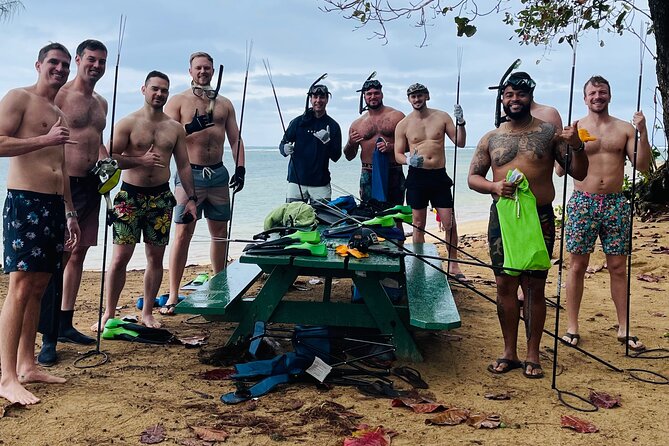
The lesson begins at Anini Beach, on Kauai’s north shore, with a 9:30 a.m. meeting time. The meeting point is 4241 Anini Road in Kilauea, and you arrange your own transportation there. This is not a hotel pickup activity, so allow time to find the location and arrive ready to get wet.
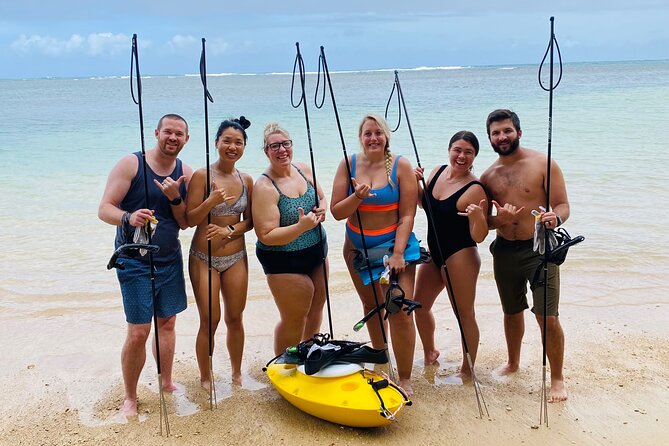
Your instructor starts on land with the basics. You learn how the spear works, how to hold it safely, how to identify native and invasive reef fish, and how to act responsibly around marine life. This first 45 minutes matters because spearfishing is not simply snorkeling with a weapon. You need to control the spear, judge distance, recognize legal and suitable fish, and avoid damaging coral or harming fish you do not intend to take.
The guides named in the feedback include Aiden, Aidden, Christian, and Tui. Aiden and Aidden received especially warm praise for patience, local experience, and clear demonstrations. Christian was also noted for keeping people in safe areas and offering a calm introduction. Tui helped a first-time snorkeler feel more at ease. Guide assignments can vary, but the teaching approach is clearly a major part of the experience.
Before entering the water, you suit up and review responsible fishing practices. Hawaii requires out-of-state visitors to carry a recreational ocean fishing license. The 24-hour nonresident license costs $20 and must be obtained through the Hawaii Department of Land and Natural Resources website. That fee is not part of the $125 tour price.
More spearfishing around the USA:
- Discover Spearfishing course
★ 5.0 · 57 reviews - Spearfishing in Chania, Crete (price is per group)
★ 5.0 · 17 reviews - Spearfishing Playa del Carmen or Tulum
★ 4.5 · 11 reviews
What the 45-minute master class actually teaches
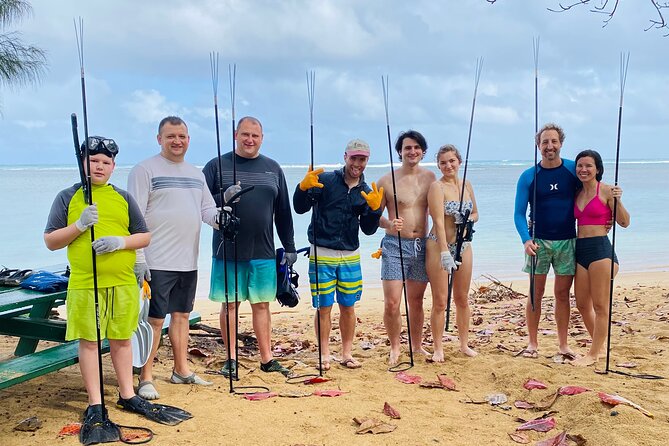
The shore lesson gives you time to get comfortable before the physical part begins. You work with the provided snorkeling equipment and traditional three-prong spear, learning the motions on land before trying them underwater. That makes this a better choice for a first lesson than an outing that simply hands you gear and sends you toward the reef.
Fish identification is another useful part of the class. You are not just looking for the largest or most colorful fish. The guide explains which reef fish are native, which are invasive, and how sustainable fishing fits into Hawaii’s marine traditions. This helps you see the reef as a living place rather than a target range.
The lesson also sets honest expectations. You may catch something, but you may not. Several people spent the full session taking shots and watching fish without bringing home dinner. Others caught one or more fish and prepared them later. One guide reportedly explained that it took him five outings to catch his first fish, a useful reminder that the skill takes practice.
I like this low-pressure approach. A successful day can mean learning to aim, recognizing fish, staying calm in the water, and seeing a turtle or ray. If your only goal is to provide dinner, you may find the $125 price disappointing.
Swimming out to the reef
After the lesson, you head from shore into the reef area for roughly two hours of guided fishing and snorkeling. The exact effort depends on conditions, but you should expect to swim a fair distance before you begin hunting. One account described the outer reef as about three football fields from shore, while another noted that the reef is a good distance out.
The water is not necessarily deep. One person reported that the deepest section was about five feet. That can make the setting feel less intimidating, especially if deep water worries you, but shallow water does not mean easy water. You still face current resistance, waves, uneven reef, and the work of swimming while carrying and using the spear.
Tide timing matters. Low tide can make the trip out and back more awkward, with a greater chance of scraping yourself on the reef. You should also expect conditions to change after rain. Murky water can make fish harder to see, even when the day remains pleasant.
Your own fins are a key part of the experience. The operator provides snorkeling equipment except fins, and the fins are required. Bring a pair that fits well and moves you efficiently. One experienced participant found inexpensive fins workable but wished for stronger dive fins while swimming against current. That is useful advice: poor fins can turn an exciting session into an exhausting one.
Two hours of fish, turtles, and trial and error
Once you reach a productive area, the lesson becomes active practice. You watch fish move through the reef, position yourself, hold the spear under tension with one arm, and wait for a safe shot. The spear works much like a short underwater slingshot, so your dominant arm can tire while you hold it ready.
You may spend more time watching than firing. Fish move quickly, and a missed shot is normal for beginners. The process has a satisfying rhythm: spot a fish, identify it, judge its size and position, aim, and decide if the shot is responsible. You are learning judgment as much as technique.
The reef itself can be the best part of the outing. People have seen large fish, eels, sea cucumbers, sea turtles, and a manta ray. Even if you bring nothing home, the activity gives you a reason to move slowly and study the seafloor. This is snorkeling with a purpose, but the wildlife remains part of the reward.
The guide may move around the group while people hunt. Because participants spread out, sometimes by 50 to 100 yards, you need to remain alert and follow the instructor’s directions. A small group of six helps, but this is not a tightly packed, step-by-step pool lesson. If you want constant personal coaching every second, tell the guide when you need help.
The physical demand deserves plain warning. You should have a strong fitness level, be proficient in swimming and snorkeling, and feel comfortable spending up to two hours in the water. One participant in mediocre shape managed the full session and wanted to continue, while another found the activity too strenuous. Your comfort with the ocean will likely matter more than your age.
More Reef and Bottom Fishing Trips in the USA:
- 4-Hour Day or Night-Time Reef Bottom Fishing Charter in Fort Lauderdale
★ 4.5 · 365 reviews - Key West 6-Hour Party Boat Fishing Trip – Affordable Reef Fishing
★ 4.5 · 325 reviews - 3-Hour Honolulu Bottom Fishing Adventure
★ 4.5 · 320 reviews - 3-Hour Honolulu Bottom Fishing Adventure
★ 4.6 · 25 reviews
The catch of the day, or a successful skunk
The tour does not promise a fish. Some people catch one quickly, while others leave with nothing but good shots and new skills. A guide may demonstrate the technique by catching a fish himself, but that does not make your own catch automatic.
If you do land a fish, the guide bags it for you to take home. In some outings, the guide has also cleaned or processed the fish and shared cooking advice. That support can turn the lesson into a memorable dinner, but the supplied details frame the experience as instruction rather than a formal catch-and-cook program.
Responsible practice is important here. You should not expect to spear whatever catches your eye. The opening lesson covers reef fish identification and sustainable behavior, and you need to follow the guide’s direction about suitable fish and safe shots. The goal is to take only what you can properly use.
I appreciate that the experience works even without a catch. The reef, fish identification, and underwater challenge provide enough substance for the $125 fee. Still, if you are comparing this with a standard snorkeling tour, remember that you are paying for instruction, gear use, and a guided activity, not a guaranteed meal.
The final 15 minutes and return to shore
The scheduled final 15 minutes are for team photos and questions. This is a useful wind-down after the water session, especially if you want to ask about fish, equipment, or ways to continue spearfishing safely.
The activity ends back at the Anini Beach meeting point. Bring your own water and snacks because neither is included. Sunscreen is also not included, and a long morning in open water can leave you exposed even when you spend much of the time looking below the surface. Apply it before the lesson and consider protective clothing if you use it.
One person reported an outing that ended after about half the expected time without a clear explanation. That appears to be an exception rather than the stated schedule, but it is worth keeping in mind that sea conditions, guide decisions, and group needs can affect the day. The planned duration is about three hours: 45 minutes on shore, roughly two hours in the water, and 15 minutes for photos and questions.
Is $125 a fair price?
At $125 per person, this sits above a basic self-guided snorkel outing but offers much more direction. You receive a 45-minute beginner class, a guided in-water session, snorkeling equipment except fins, and use of a traditional three-prong spear. The group size is capped at six, which gives the guide a reasonable chance to watch the group and offer corrections.
You must add the $20 Hawaii recreational ocean fishing license if you are a nonresident. You also supply transportation, fins, sunscreen, water, and snacks. Once those costs are included, the outing is not a cheap spontaneous activity.
The value depends on what you want. I think it is fair for someone who wants to learn a skill and experience the reef in a more active way. It is less compelling if you simply want to see coral and turtles, since a regular snorkeling trip may require less effort and equipment preparation.
The chance to take home a fish adds appeal, but it should be treated as a bonus. Pay for the instruction and the time on the reef. Consider the fish a possible extra.
Who should book this Kauai spearfishing lesson?
This activity suits you if you:
- Already feel comfortable snorkeling in open ocean water.
- Can swim steadily against some current.
- Want a hands-on introduction to a traditional Hawaiian activity.
- Enjoy learning through trial and error.
- Are comfortable with the possibility of catching nothing.
- Have the strength to hold a loaded spear with one arm.
- Want a small group rather than a large boat excursion.
It is not a good fit if you are new to snorkeling, uneasy in open water, or looking for a gentle beach activity. The guide can teach the fishing skills, but cannot replace basic water confidence. Practice snorkeling before your booking if you have not used a mask and fins recently.
Families with older children and teens may enjoy it if everyone can swim well and handle the physical effort. Couples, solo visitors, and adventurous groups also fit the format. Keep in mind that people may spread out while hunting, so children need to follow instructions and remain within the guide’s awareness.
You can cancel for a full refund up to 24 hours before the start time. Poor weather or failure to meet the minimum group size can also lead to a new date, another experience, or a full refund.
Should you book it?
Book this lesson if you want more than passive sightseeing and you are genuinely comfortable in the ocean. The strongest reasons are the patient instruction from guides such as Aiden, Aidden, Christian, and Tui, the small group limit, and the chance to see reef life while learning a useful skill.
Skip it if you need guaranteed food, dislike strenuous swimming, or have little snorkeling experience. Bring good fins, allow for current and tide, buy the required license, and set your goal at learning rather than landing a fish. With that mindset, the catch is a bonus, and the reef experience carries the day.
FAQ
Where does the spearfishing lesson meet?
The lesson meets at 4241 Anini Road, Kilauea, Hawaii 96754. The activity starts and ends at this meeting point.
What time does the lesson start?
The start time is 9:30 a.m.
How long does the activity last?
The experience lasts about three hours. This includes a 45-minute shore lesson, about two hours in the water, and roughly 15 minutes for photos and questions.
Are fins included?
No. Fins are required, but you must bring your own. Other snorkeling equipment and the traditional three-prong spear are provided.
Do I need a fishing license?
Yes. Hawaii requires out-of-state residents to have a recreational ocean fishing license. The license costs $20 for 24 hours and can be obtained through the Hawaii Department of Land and Natural Resources website.
Is transportation included?
No. You must arrange your own transportation to and from the Anini Beach meeting point.
Do I need previous spearfishing experience?
No previous spearfishing experience is required. The activity includes beginner instruction, but you must already be proficient in swimming and snorkeling.
Is catching a fish guaranteed?
No. The lesson focuses on instruction and responsible practices, and a catch is not guaranteed.
What should I bring besides fins?
Bring water, snacks, sunscreen, and your required fishing license. You should also arrive ready for a physically demanding morning in the ocean.
How many people can join the lesson?
The activity has a maximum of six participants.
More hands-on sessions around the USA
- 3 Hour Fishing Experience/Class in Juneau
★ 4.5 · 98 reviews - Cooking Class Hoi An:Local Market, Basket Boat, Fishing & Cooking
★ 5.0 · 3,660 reviews - HoiAn:Making Lantern & Cooking Class-BasketBoat Ride,Crab fishing
★ 5.0 · 162 reviews - World Class Fishing Charter Trip in Tenerife
★ 4.5 · 110 reviews
New trips around the USA
- Peacock Bass Fishing Trips near Boca Raton★ 5.0 · 18 reviews
- Boca Raton Deep Sea Fishing Trips★ 4.0 · 2 reviews
- Kona Hawaii Deep Sea Fishing Escapade on the Bite Me 6★ 5.0 · 8 reviews
- Half Day Private Cruise Tour with Snorkeling and Fishing in Kona★ 5.0 · 3 reviews
- Kona Hawaii Fishing/Snorkel Large Group Private Charter on OE★ 4.5 · 10 reviews
- Kona Hawaii Fishing/Snorkel Large Group Private Charter on OE II★ 5.0 · 9 reviews
- Half Day Afternoon Angler Charter★ 4.5 · 19 reviews
- Kona – 5 Hours Private Fishing Charter in Kailua-Kona★ 5.0 · 28 reviews
Spearfishing Trips, compared.
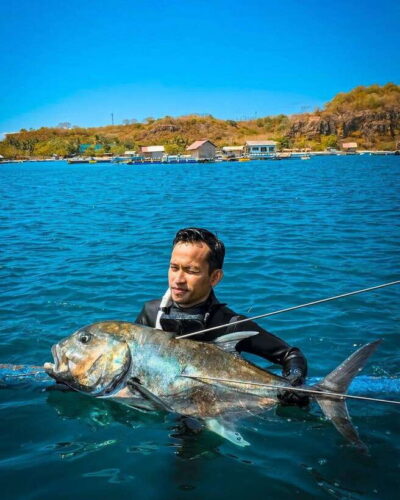
Gili Trawangan : Spearfishing with Catch & Cook Experience
Read our review →Browse the lists this tour appears in